
How wholesale works
In the wholesale scenario your customers are other operators: a PBX, a SIP trunk or another softswitch sends you calls, you terminate them through your vendors and bill the customer per minute. No device registers on the switch; calls are authenticated by the IP address they come from, and volumes are high while the margin per call is small.
How a wholesale call flows
Section titled “How a wholesale call flows”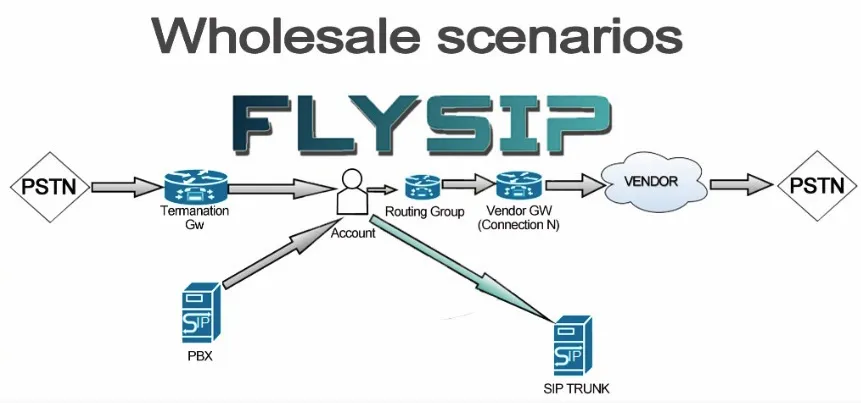
- The customer’s equipment sends an INVITE to the switch. An Authentication Rule with the customer’s IP maps the call to an Account.
- The account’s service plan prices the call with your Rates; the account’s balance and credit limit decide the maximum duration.
- The account’s Routing Group selects the vendor Connections whose Termination Routes cover the dialled prefix and orders them by the routing policy, usually least cost.
- The switch tries the connections in order until one answers. The vendor’s price from the termination route becomes your cost.
- When the call ends, one CDR is written for the customer with your price and one for the vendor with the cost. The difference is your margin.
What you configure
Section titled “What you configure”| Side | Objects | Where |
|---|---|---|
| Vendor-facing | Vendor, Connection, Termination Route with routes, Routing Group | Vendors menu |
| Customer-facing | Tariff Plan with rates, Account, Authentication Rule | Tariffs and My Customers menus |
Resellers fit in between: a Reseller customer gets its own tariff from you and sells to its own accounts under its own rates; the switch bills every level of the chain on each call.
Typical variations
Section titled “Typical variations”- Several price levels for one customer. One account per quality level, each with its own authentication rule, tariff plan and routing group, or one account with several rules that override the tariff and routing group per source IP or CLI prefix.
- Tech prefixes. The customer dials
#1234plus the number to select a route; a CLD Translation Rule on the rule or the connection strips it. See Tech prefixes. - Postpaid customers. A credit limit instead of a prepaid balance, monthly statements from Summary Reports, and low balance notifications when the exposure grows.
What’s next
Section titled “What’s next”- Set up a wholesale customer: the full walkthrough.
- Wholesale scenario checklist: the same steps as a list to tick off.
- Routing and Rating and billing: the concepts behind steps 2 to 5.