
Asserted identity and privacy
Between trusted networks, the caller’s real number often travels in a separate header instead of From: P-Asserted-Identity (RFC 3325) or Remote-Party-ID. FlySIP turns either header into one internal identity of the call. You can then authenticate the call by it, pass it on, convert it to the other header, generate it from the CLI, or put it into From. The same mechanism carries the caller’s request for privacy and hides the number when the account asks for it.
How it works
Section titled “How it works”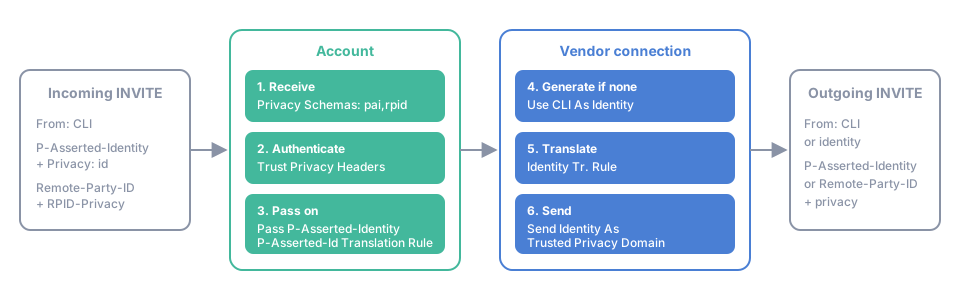
-
Receive. The switch reads
P-Asserted-Identitywith itsPrivacyheader, andRemote-Party-IDwithparty=callingand itsRPID-Privacyheader. Privacy Schemas on the account lists the accepted headers in order of preference:pai,rpidor both. The defaultpai,rpidprefersP-Asserted-Identitywhen the caller sends both. The username of the chosen header becomes the identity.Privacy: id, orprivacy=full,uriornamein Remote-Party-ID, means the caller asks to stay anonymous. -
Authenticate. With Trust Privacy Headers on the account, the switch also matches authentication rules against the identity number, not only against the CLI. Identity Auth Mode in System Management → SIP Features → SIP decides when the CLI still counts:
Mode The CLI is used for authentication Strict (default) Only when the caller sent no identity header Relaxed When no rule matches the identity; the identity is tried first Mandatory Never; the call must authenticate by its identity The mode applies to accounts with Trust Privacy Headers only. Other accounts authenticate by CLI as usual.
-
Pass on. Pass P-Asserted-Identity on the account lets the received identity, from either header, continue to the vendor. P-Asserted-Id Translation Rule on the account rewrites it first. Without this option the received identity and the caller’s privacy request stop at the account.
-
Generate. When no identity is passed on, a connection with Use CLI As Identity creates one from the CLI.
-
Translate. Identity Tr. Rule on the connection rewrites the outgoing identity, received or generated.
-
Send. Send Identity As on the connection picks the header for the vendor: Off (default), P-Asserted-Identity or Remote-Party-ID. The switch builds a new header with the identity as username, its own address as host and the caller name as display name. It sends the header only when Trusted Privacy Domain is on for the connection, which is the default.
Use Identity As CLI on the connection replaces the number in From with the identity after step 5. Use it when the vendor ignores identity headers but must see the real number.
Privacy
Section titled “Privacy”The call is anonymous when the account has Hide CLI, or when the caller asked for privacy and the account passes the identity on. The switch then empties the CLI in From and sends Anonymous as the caller name, whatever Send Identity As is. Depending on Send Identity As it also tells the vendor:
| Send Identity As | Trusted Privacy Domain on | Trusted Privacy Domain off |
|---|---|---|
| P-Asserted-Identity | P-Asserted-Identity and Privacy: id |
Privacy: id only |
| Remote-Party-ID | Remote-Party-ID with privacy=full |
RPID-Privacy: party=calling;privacy=full only |
| Off | nothing | nothing |
So an untrusted vendor learns that the caller is anonymous but never sees the real number.
Key terms
Section titled “Key terms”- Account — a SIP identity (username/password or IP) owned by a customer that originates and receives calls and carries its own balance.
- Connection — a route to a vendor (SIP host, port, protocol, codecs) used by routing to send calls.
- CLI — Calling Line Identification: the caller’s number presented on an outgoing call. In FlySIP it is the username of the
Fromheader. - Authentication Rule — a rule that identifies the account for an incoming call by source IP, CLI, called number or other SIP fields instead of a password.
- Translation Rule — a regular-expression rule that rewrites the called or calling number before rating or routing.
Common scenarios
Section titled “Common scenarios”Pass the caller’s P-Asserted-Identity to the vendor
Section titled “Pass the caller’s P-Asserted-Identity to the vendor”On the account, keep pai in Privacy Schemas and turn on Pass P-Asserted-Identity. On the vendor connection, set Send Identity As to P-Asserted-Identity and keep Trusted Privacy Domain on. Add P-Asserted-Id Translation Rule or Identity Tr. Rule when the vendor expects another number format.
Receive Remote-Party-ID, send P-Asserted-Identity
Section titled “Receive Remote-Party-ID, send P-Asserted-Identity”Set Privacy Schemas to rpid and turn on Pass P-Asserted-Identity on the account. Set Send Identity As to P-Asserted-Identity on the connection. The switch converts the header; the other direction works the same way.
Always send an identity built from the CLI
Section titled “Always send an identity built from the CLI”Turn off Pass P-Asserted-Identity on the account and turn on Use CLI As Identity on the connection. Every call to this connection then carries an identity equal to the CLI, whatever the caller sent.
A PBX sends a generic number in From and the extension’s number in P-Asserted-Identity
Section titled “A PBX sends a generic number in From and the extension’s number in P-Asserted-Identity”Turn on Trust Privacy Headers and create the authentication rule for the number the PBX puts in P-Asserted-Identity. With Strict the identity decides whenever it is present; switch to Mandatory if calls without an identity must fail. To show the vendor the identity instead of the generic number, turn on Pass P-Asserted-Identity and Use Identity As CLI on the connection.
Related pages
Section titled “Related pages”- Accounts: Advanced tab, SIP / Services and Privacy sections
- Connections: Advanced Parameters and Number Translation tabs
- System parameters: Identity Auth Mode
- Authentication
- Number translation
- Pass-through headers